Jan 9, 2026
The AI Copilot Trap: Why Real World Engineering AI Must Live Above the Individual Platforms
Introduction: The Architecture of Autonomous Engineering
The Problem: The "AI Copilot Trap"
The current wave of AI in engineering is focused on "Assistants"—chatbots that sit inside a specific tool (like Ansys or SolidWorks) to answer questions or click buttons. While helpful, these assistants suffer from the same fatal flaw as the software they inhabit: they are siloed.
Real engineering does not happen in a single window. It is a fragmented, messy workflow that spans:
Requirements (SysML/MBSE)
Design (CAD)
Data Management (PLM)
Physics (CAE)
Reporting (PPT& XLX).
A "Native Copilot" inside Ansys cannot see the requirements in Jama.
A "Native Copilot" in SolidWorks cannot understand the mesh constraints in Fluent.
Native copilots optimize the individual task within a walled garden, but remain structurally blind to the fragmented, multi-vendor workflow—the upstream requirements, downstream handoffs, and broken data—where the true cost and risk of engineering actually reside.
The Solution: Living "Above the Platform"
Cosmon Nexus is not an assistant. It is an Infrastructure Layer—an Engineering Operating System that lives above the vendor platforms. It acts as the connective tissue that unifies the fragmented engineering stack.
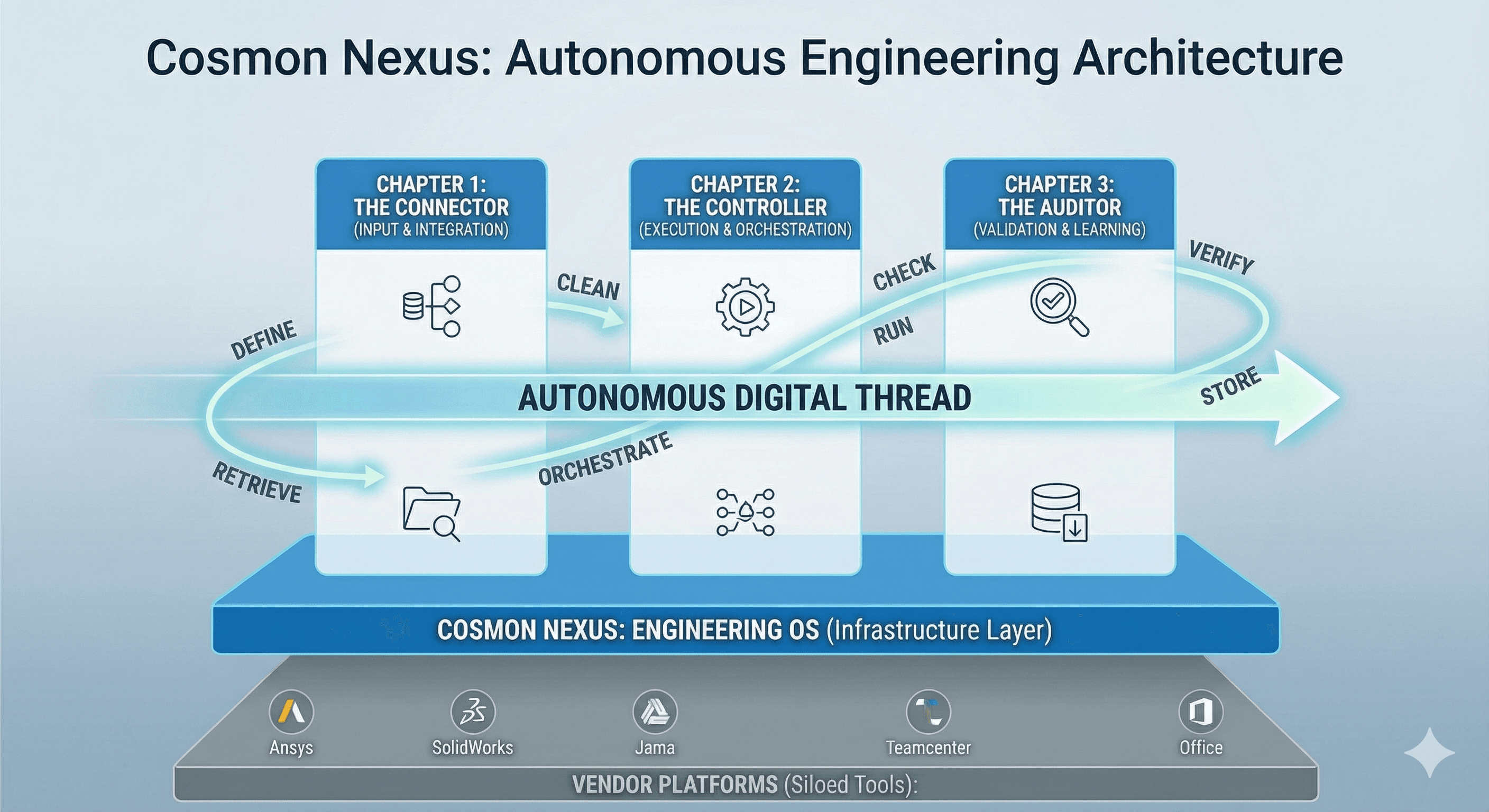
Instead of just "chatting" with simulation software, Cosmon orchestrates 8 Infrastructure Layers organized into three strategic chapters. This architecture transforms simulation from a series of manual tasks into a continuous, automated digital thread.
The Three Pillars of the Cosmon Nexus OS
To deliver a true "Autonomous Engineering" experience, the Cosmon OS is structured into three distinct phases of the engineering lifecycle:
Chapter 1: The Connector (Input & Integration)
Establishing the Digital Context
Before any physics can be solved, the context must be established. The Connector layers ensure that the simulation is not an isolated experiment but a valid derivative of the master data. It breaks the "Wall of Silence" between the System Engineer (Requirements), the Designer (CAD), and the Analyst (Simulation).
1.1 Systems Requirements Integrator (MBSE Layer)
Connecting the "How" (Simulation) back to the "Why" (Business Requirements).
The Exact Problem: Simulation is functionally disconnected from business requirements. Analysts often run tests based on outdated specs, static documents, or verbal instructions, leading to verification gaps and expensive late-stage failures.
The AI Unlock (Previously Impossible): Semantic Translation of Intent.
Previously, connecting MBSE to CAE required brittle, hard-coded parameter mapping.
The Cosmon Agent acts as a semantic bridge. It reads natural language requirements in tools like Jama or Cameo (e.g., "Maximum deflection under peak load must not exceed 2mm") and autonomously translates that intent into the exact boundary conditions and pass/fail criteria in the simulation setup.
1.2 Automated Geometry Preparation (CAD Layer)
Bridging the gap between Design and Physics.
The Exact Problem: High-fidelity manufacturing CAD is unsuitable for simulation. Analysts waste upwards of 70% of their time manually "cleaning" geometry—removing thousands of fasteners, logos, and complex details—just to make it meshable.
The AI Unlock (Previously Impossible): Physics-Aware Geometric Recognition.
Traditional CAD macros are dumb; they delete features based on size, often removing critical structural elements.
The Cosmon Agent uses geometric deep learning to understand the function of a feature. It recognizes that a "bolt hole" in a structural analysis needs to be idealized as a beam connection, whereas in a CFD analysis, it needs to be capped. It automates defeaturing with engineering judgment.
1.3 Enterprise Data Contextualization (PLM/PDM Layer)
Respecting the data hierarchy.
The Exact Problem: Engineers frequently perform simulations on "zombie data"—files stored on local desktops that are obsolete or unreleased revisions—wasting compute resources and creating liability.
The AI Unlock (Previously Impossible): Intelligent Lifecycle Filtering.
Standard integrations just open files; they don't understand metadata context.
The Cosmon Agent interprets PLM metadata (maturity status, effectivity dates) to ensure it is impossible to run a certification simulation on anything other than the correct, released revision of the data.
Chapter 2: The Controller (Execution & Orchestration)
Managing Execution Complexity
This is the engine room. Once the inputs are validated, the Controller layers handle the complexity of translation, execution, and resource management. It navigates the messy reality of multi-vendor APIs, enforces strict corporate governance to prevent "garbage in," and optimizes the expensive compute resources required to get the job done.
2.1 Unified Workflow Orchestration (Scripting Layer)
Handling the messy reality of engineering tools.
The Exact Problem: Automating workflows across multi-vendor tools (e.g., SolidWorks → Hypermesh → Ansys) is notoriously difficult, requiring brittle custom scripts that break with every software update or dirty geometry file.
The AI Unlock (Previously Impossible): Self-Healing Polyglot Scripting.
Traditional automation stops cold when an error occurs.
The Cosmon Agent generates necessary scripting on the fly across different vendor APIs. Crucially, it possesses "self-healing" capabilities. If a meshing step fails due to sliver surfaces, the Agent reads the error code, autonomously applies a virtual topology fix, and re-submits the job without human intervention.
2.2 HPC & License Optimization (Compute Layer)
Aligning with the customer's bottom line.
The Exact Problem: Engineering organizations bleed money due to inefficient use of compute resources—running simple jobs on expensive cloud hardware or blocking critical high-value licenses with low-priority tasks.
The AI Unlock (Previously Impossible): Predictive Cost/Speed Arbitrage.
Current schedulers are queue-based; they don't understand the physics of the job.
The Cosmon Agent analyzes the model's complexity (element count, physics type) before submission to predict solve time and memory needs. It then makes a real-time arbitrage decision: run locally to save cost, or burst to specific cloud hardware for speed, optimizing the ROI of every token.
2.3 Simulation Governance Framework (Governance Layer)
The strongest "Enterprise" argument.
The Exact Problem: Democratization efforts fail because junior engineers misconfigure complex solvers, leading to plausible-looking but dangerously incorrect results ("garbage in, garbage out").
The AI Unlock (Previously Impossible): Context-Aware Semantic Guardrails.
Traditional templates are rigid and cannot adapt to novel geometry.
The Cosmon Agent understands corporate Standard Operating Procedures (SOPs) as semantic rules. It actively monitors the setup in real-time, blocking runs that violate physics best practices (e.g., "Stopping run: You are using a k-epsilon turbulence model on highly separated flow, which violates SOP 4.1.").
Chapter 3: The Auditor (Validation & Learning)
Traceability and Knowledge Retention
A simulation is useless if the insights are lost or untrusted. The Auditor layers ensure that every result is traceable, peer-reviewed, and indexed for future use. It transforms the "Graveyard" of lost simulation files into a searchable asset, ensuring that the organization gets smarter with every run.
3.1 Automated Review & Traceability (Review Layer)
Transforming simulation from a siloed task into a collaborative process.
The Exact Problem: Simulation design reviews are manual, reliant on static PowerPoint screenshots, and lack rigorous data lineage, making regulatory audits (FAA, FDA) painful and expensive.
The AI Unlock (Previously Impossible): Semantic Physics "Diffing."
The Cosmon Agent generates automated "Pull Requests" for physical systems. It doesn't just show that pixels changed; it explains the engineering significance (e.g., "V2 increased mass by 4% but reduced peak Von Mises stress at the fillet by 15%"). It stamps every result with an immutable digital signature linking inputs for instant auditability.
3.2 Engineering Knowledge Retrieval (Legacy Data Layer)
Turning the "Graveyard" of lost data into value.
The Exact Problem: The vast majority of engineering insight is generated during "work-in-progress" iterations that never make it into the PDM system. This valuable knowledge dies in unsearchable "scratch" folders, leading to constant rework.
The AI Unlock (Previously Impossible): Geometric and Unstructured Indexing.
Standard enterprise search can only find filenames or text tags.
The Cosmon Agent indexes the actual physics and geometry of files in WIP locations. It enables engineers to query past experience conceptually: "Show me past thermal analyses of battery packs with this specific cooling channel geometry that failed due to thermal runaway." It finds prior art based on shape and physics, regardless of naming conventions.
The Synergy Effect: The Power of Cross-Layer Autonomy
Before detailing the workflow, it is critical to understand the unprecedented capability unlocked when an AI Agent operates across all these layers simultaneously.
Traditionally, the "integration" between these layers happens in the engineer's head. A human must read a requirement in Jama, open CAD to clean geometry, write a script for Ansys, check an Excel spreadsheet for corporate rules, decide where to run the job, and then manually compile a report.
The AI Paradigm Shift:
Cosmon is not just automating individual tasks within these silos; it is automating the transition between them. Because the Agent has semantic understanding of requirements, geometric understanding of CAD, and physics understanding of solvers, it creates a fully autonomous, closed-loop workflow previously impossible.
What Cross-Layer AI Enables:
Autonomous Change Propagation: A requirement change in SysML can automatically trigger CAD updates, re-run simulations under strict governance, and generate a traceable review package without human intervention until the final sign-off.
Holistic Optimization: The Agent doesn't just optimize the mesh; it optimizes the entire chain—balancing requirement margins, manufacturing constraints, and compute costs in a single decision matrix.
Putting it Together: The Integrated Flow
Here is how the Cosmon Nexus Engineering OS executes a single engineering change order:
Define (Chapter 1): The Agent detects a changed Requirement in SysML ("Load increased to 5kN").
Retrieve (Chapter 1): It pulls the latest
Releasedgeometry from Teamcenter.Clean (Chapter 1): It uses the Automated Geometry Preparation layer to defeature the model for simulation.
Orchestrate (Chapter 2): It writes a dynamic Python Script to set up the boundary conditions in Ansys.
Check (Chapter 2): It verifies the setup against Corporate SOPs (Simulation Governance).
Run (Chapter 2): It checks license availability and Bursts the job to the cloud via the HPC Optimizer.
Verify (Chapter 3): It generates a Diff Report for the Lead Engineer to approve.
Store (Chapter 3): It indexes the result in the Knowledge Graph so the next engineer doesn't have to repeat the work.