Dec 14, 2025
Cost of Correction: From Generative Chat to Collaborative Engineering Intelligence
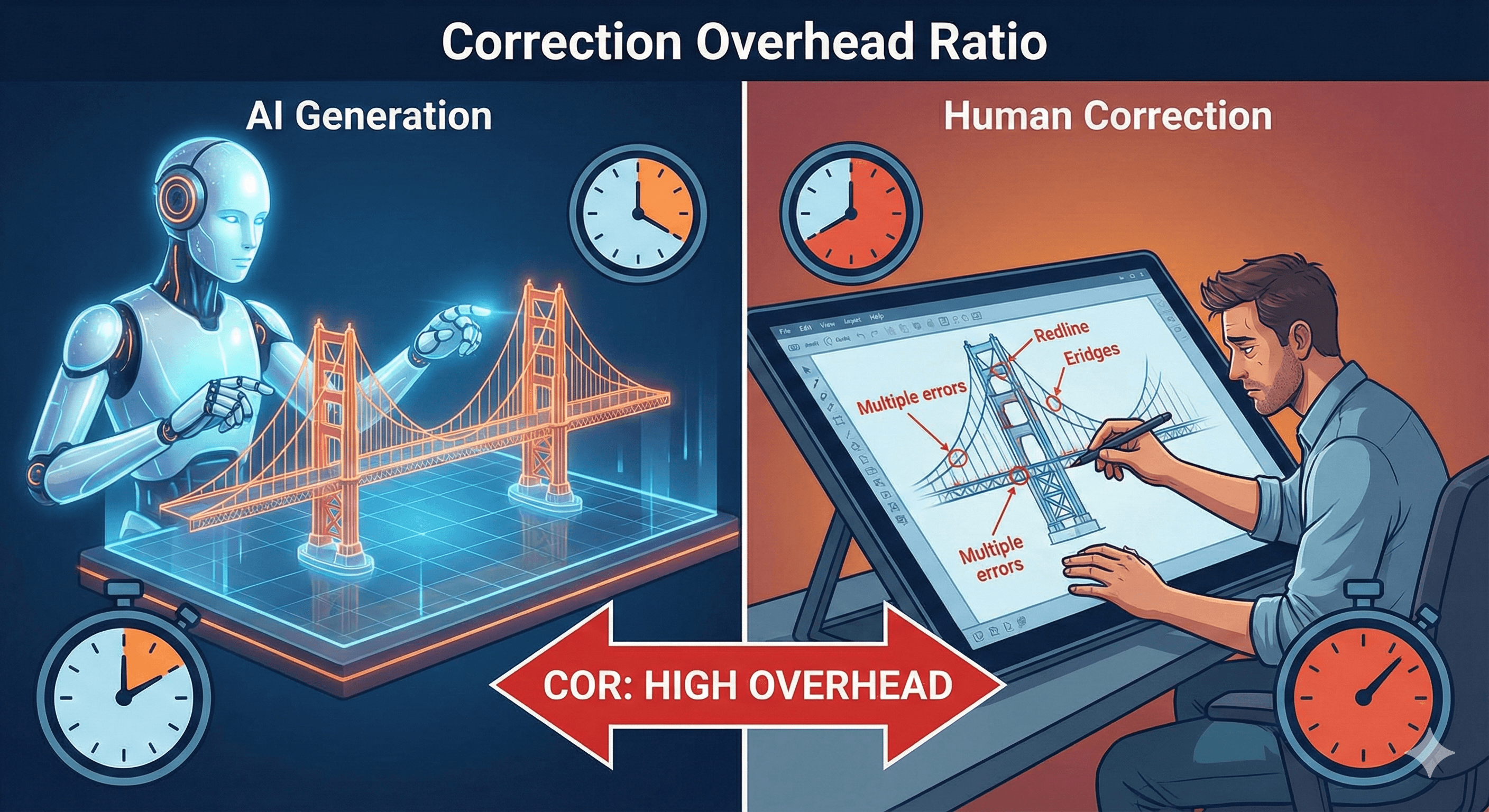
By: Noah Weber
1. The Post-Chatbot Era: Redefining Engineering Intelligence
The trajectory of Artificial Intelligence in the engineering sector has reached a decisive pivot point. For the better part of the last three years, the industry has been operating under a paradigm that can best be described as "ChatGPT thinking"—a mode of interaction defined by conversational fluency, text-based reasoning, and a reliance on general-purpose Large Language Models (LLMs) as universal problem solvers. This paradigm, while revolutionary in the domain of creative writing and basic code generation, is increasingly revealing its limitations when applied to the rigorous, deterministic, and physically constrained world of engineering.
At Cosmon, we contend that the metrics which fueled the rise of the chatbot—Pass Rates, Tokens Per Second, and Human Preference Eloquence—are not merely insufficient for engineering; they are actively misleading. In the high-stakes environments of mechanical design, structural analysis, and systems engineering, a model that is "90% correct" is effectively 100% useless if the remaining 10% violation occurs in a critical load path or a geometric tolerance. The gap between a plausible answer and a functional design is the difference between a successful product launch and a catastrophic failure.
The introduction of AI Agents and Copilots into engineering disciplines requires a fundamental restructuring of how we value and measure these systems. We must move beyond the binary assessment of accuracy—"Did the AI get the answer right?"—to a nuanced quantification of collaboration. The question is no longer about the capability of the model in isolation, but about the efficacy of the Human-AI System. Does the introduction of the agent accelerate the engineer's workflow, or does it introduce a layer of "cognitive debt" required to verify and correct the AI's output?
To answer this, we introduce a new operational framework rooted in DEBIT—reimagined for the context of Human-AI collaboration as Diversity of Solvers, Equity of Effort, Belonging, Inclusion of Context, and Trust. Alongside this framework, we propose metrics such as Information Gain per Turn (IGT), Correction Overhead Ratio (COR), and Reasoning Robustness (RR). These metrics, grounded in the latest research from 2024 and 2025, provide the granular visibility needed to transition from "Chat" to true Engineering Intelligence.
2. The Productivity Paradox: Why "Chat" Metrics Fail in Physical Reality
To understand the necessity of a new measurement framework, we must first confront the empirical reality of AI adoption in complex technical fields. The prevailing assumption has been that the introduction of high-capability LLMs would linearly correlate with productivity gains. However, recent rigorous testing has exposed a "Productivity Paradox," where the perception of speed masks a measurable decline in actual throughput [1].
2.1 The Illusion of Velocity: Deconstructing the METR Study
The most significant data point challenging the "Chat" paradigm comes from the METR (Measuring the Impact of Early-2025 AI on Experienced Open-Source Developer Productivity) study, a randomized controlled trial conducted in mid-2025 [1]. This study provides a controlled microcosm of the challenges facing engineering AI.
The study recruited 16 highly experienced developers to resolve real-world issues in massive, complex open-source repositories, averaging over one million lines of code [1]. These were not trivial algorithmic puzzles but representative tasks requiring deep contextual understanding. The developers were equipped with state-of-the-art agentic tools, including Cursor Pro powered by Claude 3.5 and 3.7 Sonnet [2].
The results were stark and counter-intuitive:
The Reality of Slowdown: Developers using AI tools took 19% longer to complete their tasks compared to the control group working without AI assistance [1, 2].
The Perception of Speed: Despite this measurable slowdown, the participants believed they were working 20% faster [2].
The Expectation Gap: Prior to the study, both the developers and external experts predicted a productivity boost of approximately 24% [3].
This data reveals a dangerous disconnect. If an engineering organization relies solely on "User Sentiment" or "Perceived Helpfulness" (common metrics in the Chat paradigm), they would view the deployment as a massive success, while their actual engineering velocity degrades by nearly 20%.
2.2 The Anatomy of the Slowdown: Correction Overhead
Why does the addition of a "superintelligent" assistant slow down an expert? The analysis of the METR study, supported by commentary from software engineering experts, isolates the root cause: Correction Overhead [2].
In a "Chat" workflow, the AI generates content rapidly. However, in technical fields with high quality standards—such as compiler design or, by extension, aerospace engineering—the cost of verification is non-trivial. The AI often produces solutions that are plausible but subtly incorrect.
The Reviewer's Burden: The engineer shifts from a "Creator" mode to a "Reviewer" mode. Reviewing code or designs that one did not create is often cognitively more taxing than creating them from scratch.
Contextual Blindness: The study noted that general-purpose models struggled with the "implicit rules" of large repositories [3].
The Mirage of Progress: The "illusion of speed" stems from the rapid generation of text or code. The engineer feels productive because artifacts are being created, but progress is stalled by the need to debug.
2.3 The Implications for Physical Engineering
If this slowdown occurs in software—where the "physics" is logical and testing is automated—the implications for physical engineering are even more profound. In Computer-Aided Engineering (CAE), the "compile time" is often a simulation run taking hours.
Cost of Error: A syntax error in code is caught by the compiler in seconds. A geometric interference in a complex assembly might only be caught after a 24-hour meshing and solving process.
Parametric Fragility: While software code can be refactored easily, CAD geometry relies on a strict hierarchy of dependencies (the "Feature Tree"). An AI might generate a visually perfect bracket, but if it fails to define robust parent-child relationships, a single update can cause the entire model to collapse.
Therefore, accuracy metrics like "Pass Rate" on static benchmarks are insufficient. We need metrics that capture the dynamic cost of collaboration.
3. The New Benchmarking Landscape: Simulation as the Ground Truth
Recognizing the inadequacy of text-based evaluations, the research community has shifted in 2024 and 2025 toward Simulation-Based Benchmarking. These benchmarks do not ask "What is the answer?"; they ask "Does the design work?"
3.1 EngDesign: The "Turing Test" for Engineering Capability
The EngDesign benchmark [5], accepted to NeurIPS 2025, represents the gold standard for evaluating engineering agents. Unlike traditional QA benchmarks, EngDesign employs Executable Evaluation Pipelines [6]. When a model proposes a solution, the benchmark generates the netlist or geometry, runs the simulation, and checks if the system meets performance specifications.
Critically, the benchmark found that without a structured "System 2" planning capability—or access to external solvers—current LLMs cannot "guess and check" their way to a functional design.
3.2 QuArch: Measuring High-Order Architectural Reasoning
QuArch [7] reveals the "Consultant's Gap." While LLMs excel at Recall (retrieving facts), they struggle significantly with Analysis (predicting system behavior). The drop-off in performance from Recall to Analyze quantifies the model's inability to model the physics of the system [8].
3.3 DesignQA: The Challenge of Multimodal Compliance
DesignQA [9] benchmarks Multimodal LLMs (MLLMs) on their ability to understand complex documentation, such as Formula SAE rules. The findings uncovered significant gaps in Visual Grounding. Models could see the image, but struggled to map the semantic constraint (text) to the geometric feature (image) [10].
4. The DEBIT Framework for Engineering Agents
To operationalize these insights, Cosmon proposes a new strategic framework. We adapt the corporate acronym DEIB into DEBIT to define the requirements of a high-functioning Human-AI Engineering Team.
D - Diversity (of Solvers): A robust engineering workflow requires a diversity of specialized intelligences—Geometric Agents for topology, Physics Agents for solvers, and Compliance Agents for standards. We measure this via the Solver Utilization Rate.
E - Equity (of Effort): The AI should perform the heavy lifting of verification. If the AI is "lazy" (hallucinating), the human pays the price. We measure this via the Correction Overhead Ratio (COR).
B - Belonging: The agent must be secure and aligned with the enterprise environment (SOC2 compliance) [14].
I - Inclusion (of Context): The agent should have "zero-shot" understanding of the project context by living inside the PLM and CAD workflow, not in an isolated chat window.
T - Trust: The foundation of the relationship, built on Reasoning Robustness and transparency.
5. Defining the New Metrics: A Technical Deep Dive
To move from philosophy to practice, we must define the mathematical metrics that Cosmon Nexus uses to quantify the DEBIT framework.
5.1 Information Gain per Turn (IGT)
IGT measures the "velocity" of the solution in the design space. We optimize for high-IGT interactions where a single turn "prunes" significantly more of the design space than a standard chat interaction [15].
IGT(t) = H(D_t) - H(D_t+1)
Where H(D) is the entropy of the valid design space.
5.2 Correction Overhead Ratio (COR)
COR quantifies the Equity of the collaboration. It explicitly accounts for the time lost to the "Illusion of Speed."
COR = (T_review + T_debug + T_rework) / T_manual_generation
COR > 1.0: The AI is slower than manual work (The METR Result).
COR < 0.5: The AI provides a 2x leverage.
5.3 Token Waste Ratio (TWR)
TWR measures the efficiency of Inclusion. It tracks the fraction of generated tokens that are redundant given the context and user expertise [15].
TWR = (Tokens_redundant + Tokens_hallucinated) / Tokens_total
5.4 Reasoning Robustness (RR)
RR measures the stability of the collaboration. If the engineer changes the phrasing slightly, or if the load case changes by 1%, does the AI's design change unpredictably?
RR = Consistency(Solution_A, Solution_A') / Perturbation(Delta)
6. The Cosmon Solution: Nexus & Agentic Workflows
Nexus is designed not as a chatbot, but as an Agentic Workflow Engine that scores highly on the DEBIT framework.
Case Study: The "Copilot for Analysis"
In a manual workflow, an engineer might spend 120 minutes on setup and analysis. With Nexus, the agent automatically identifies mating surfaces, scripts the solver, and presents a converged stress plot. The human review time drops to 5 minutes.
Correction Overhead Ratio (COR): Reduced from 1.0 to 0.04.
Iteration Velocity: The engineer can now run 20 design iterations in the time it previously took to run one.
7. Strategic Recommendations for Engineering Leaders
The shift from "Chat" to "Collaboration" requires a change in how organizations evaluate AI tools.
Abandon "Pass Rate" for "Value Add": Stop asking about GSM8K scores. Ask: "What is the Correction Overhead Ratio of this tool in a standard workflow?"
Demand "Inclusion": Do not accept "Sidecar" AI. Demand "Native" AI that has read/write access to the CAD kernel.
Measure "Reasoning Robustness": Test the tool's stability against perturbed inputs.
8. Concluding Remarks
The METR study has provided the empirical "smoking gun": without deep integration and verification, AI can be a drag on productivity. To truly quantify the collaboration between Human and AI in engineering, we must adopt a framework rooted in Physics, Context, and Workflow.
For Cosmon, this is the mandate: We do not build chatbots. We build collaborators. We build systems that understand the geometry, respect the physics, and share the load.
Table 1: The Metrics of Collaborative Engineering
Metric | Definition | "Chat" Equivalent | Target Value |
Correction Overhead Ratio (COR) | Time spent fixing AI / Time saved. | Speed (Tokens/Sec) | < 0.5 |
Information Gain per Turn (IGT) | Reduction in design space entropy. | Fluency / Perplexity | High |
Reasoning Robustness (RR) | Stability of solution across perturbed inputs. | Accuracy (APR) | > 0.9 |
Solver Utilization Rate | % of tasks routed to specialized solvers. | Model Parameter Count | High |
Contextual Grounding Score | % of refs to specific local assets. | Retrieval Recall | 100% |
Works Cited
[1] A METR Study Reveals that AI Slows Down Experienced Developers - ActuIA
[2] METR's AI productivity study is really good - Sean Goedecke
[3] AI coding tools make developers slower, study finds - The Register
[4] Space-Radiation-Tolerant Repository - GitHub
[5] EngDesign Benchmark - GitHub Pages
[6] Benchmarking the Engineering Design Capabilities of LLMs - arXiv
[7] QuArch: A Benchmark for Evaluating LLM Reasoning in Computer Architecture - ResearchGate
[8] QuArch: A Benchmark for Evaluating LLM Reasoning - OpenReview
[9] DesignQA: A Multimodal Benchmark for Evaluating LLMs - arXiv
[10] DesignQA Paper - Autodesk Research
[11] DesignQA: A Multimodal Benchmark - ResearchGate
[12] A Dataset for Material Selection in Conceptual Design - arXiv
[13] AI-Driven Material Selection - IJRPR
[14] Cosmon: AI for Mechanical Engineering & Simulation Software - Cosmon
[15] Quantifying Information Gain and Redundancy in Multi-Turn LLM - OpenReview
[16] 3 Hidden Qubit Costs Draining Quantum Budgets - SpinQ
[17] An Interactive Benchmark for LLM Agents in Long-Context Software - arXiv