


Case study · Industrial
GEARBOX HOUSING DFM REVIEW
Agentic design-for-manufacturing with Argus and SolidWorks
Tools
Argus · SolidWorks
Outcome
7 issues detected and resolved · 2–3 hrs saved · $140 saved per part


Case study · Industrial
What’s inside
A walk-through of how Argus ran a design-for-manufacturing audit on a machined 6061-T6 gearbox housing in SolidWorks, independently matching an experienced engineer’s findings, then updating the CAD model itself. What the agent caught on its own, and where the engineer steered.
Summary
Argus conducted a full DFM review of a gearbox housing and implemented design updates directly in SolidWorks.
Argus worked with the engineer in SolidWorks to audit a machined 6061-T6 gearbox housing, flagged 7 issues an experienced engineer would raise, then made every approved change in the model. Together with Argus, the engineer saved $140 per part and 60% of engineering time on this study.
60%
Engineering time saved
$140
Machining & scrap cost saved · per part
7
DFM issues identified
Time and cost are modeled engineering estimates (a junior-engineer workflow with senior review).
Problem
A gearbox housing has to hold bearing bores in precise alignment. As drawn, this particular design is expensive to manufacture, and identifying where cost can be reduced typically requires a senior engineer to conduct a design review.
01
High manufacturing expense
About 96% of the starting block is machined off, over thin walls three inches deep that are slow to cut and prone to distortion, leading to increased manufacturing costs.
02
Expert work, done manually
A thorough manufacturing pass across setups, tooling, tolerances and feature geometry is senior-engineer work. Each approved change is then made in the CAD model manually.

+ Benefit to engineer
Hand the design review of the part to the agent and it runs the first-pass audit at senior level, ranks the fixes by cost impact, and makes the design changes in the model following engineer approval. The engineer collaborates to judge the trade-offs and own the final review.
Methodology
The engineer briefed Argus on the housing’s function, material (6061-T6) and process (CNC from billet), and objective to review the design. Argus returned a prioritized list of issues and a proposed fix. The engineer reviewed and selected which design changes to make, and Argus applied the design changes to the CAD model directly in SolidWorks, one at a time. Argus proposed and the engineer confirmed.


AS-MODELED HOUSING (INTERIOR AND UNDERSIDE) · 6061-T6 · 238 CM³ FINISHED · 3 BEARING BORES · 4 COVER STANDOFFS · 4 BOTTOM STANDOFFS · SIDE SLOT
Prioritized DFM findings · Argus-identified · engineer-reviewed
Priority | Manufacturing issue | Recommended change |
|---|---|---|
P1 | 96% material removed from solid billet | Near-net cast blank at volume; CNC only functional faces |
P1 | 1/16-in walls, 3-in-deep pocket (48:1) | Thicken walls to ≥0.125 in |
P1 | 4–5 setups; features on 4+ faces | Consolidate setups; drop the slot and engraving |
P2 | Three tall island bearing bosses | Reduce boss height; blend into the floor/wall |
P2 | Non-standard bearing bore (Ø0.523 in) | Resize to Ø0.500 in with an H7 seat |
P3 | Small 0.030-in fillet radii | Open radii to 0.125 in |
P3 | Mixed #6-32 / #10-32 threads | Standardize threads to #10-32 |
Results
Feature | Before | After | Manufacturability gain |
|---|---|---|---|
Wall thickness | 0.0625 in (1/16″) | 0.125 in | Heavier, faster passes; stiffer housing |
Corner & fillet radii | 0.030 in | 0.125 in | Larger standard end-mills; stronger corners |
Bearing bore | Ø0.523 in (non-standard) | Ø0.500 in (H7 seat) | Standard reamer & off-the-shelf bearings |
Bearing-boss height | 0.75 in | 0.375 in | Shorter tools, less island clearing |
Bottom standoffs | Protruding below base | Re-oriented inside; base planar | Underside finishes in one facing pass |
Tapped holes | #6-32 & #10-32, through-all | #10-32, blind at 0.380 in | Fewer tap changes; simpler inventory |
Side slot & engraving | Curved wall / 0.030-in cut | Removed | Fewer setups; a machining op eliminated |
Argus modified the CAD model in SolidWorks once the engineer approved Argus’ proposed design changes.
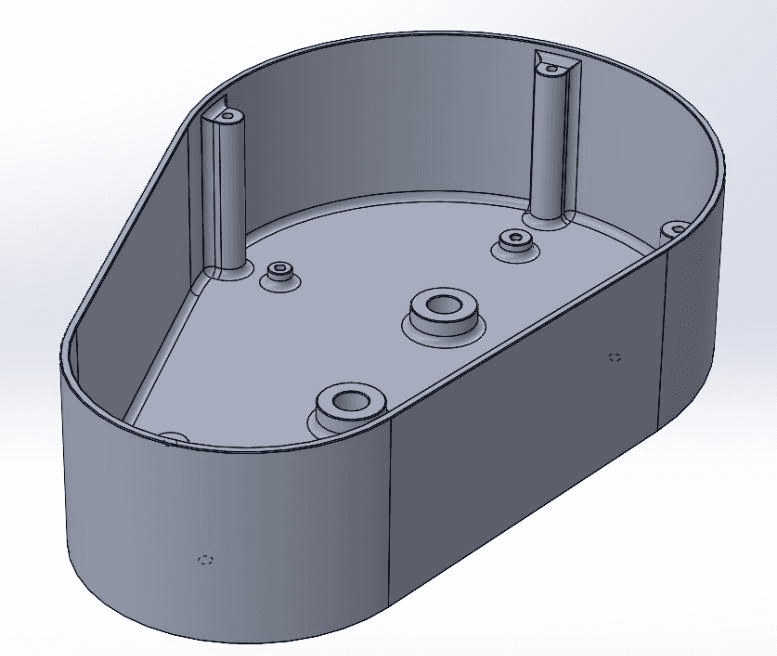
Updated Housing Design

Reoriented Standoffs

Increased Wall Thickness & Radii

Reduced Boss Height & Thread Depth
Agent Design Input
This exercise tested whether an agent could do the senior-level part of a DFM and the corresponding design changes. The design changes Argus made reduced machining and scrap costs by about $140 per part.
+
Where the value compounds
The senior-level DFM review that used to gate every production release is now a repeatable step. Now this workflow lives in Argus: reading the part, prioritizing the fixes and editing the model, running the same review on the next housing design will be faster.
Estimated cost savings at volume
Volume | Largest savings opportunity | Estimated total savings |
|---|---|---|
Prototype (10 pcs) | Machining & scrap | $780–1,400 |
Low production (100 pcs) | Tooling standardization | $8,000–14,000 |
Production (500+ pcs) | Near-net casting vs machining | $50,000+ · per-part cost down 40–60% |
+
Understands design principles
Argus laid out what governs a good housing (bore alignment, center-distance control, datum strategy, stiffness) and reviewed against those principles.
$
Reduced manufacturing costs
Larger fillets, fewer setups, a standard bore and threads, thicker walls and simpler underside bosses eliminate about $140 in recurring machining and scrap cost from every gearbox housing.
→
The engineer’s next move
The engineer conducts a final DFM review of the Argus-updated model, confirming the engineering intent is intact and no critical feature or function was lost, and makes a final decision on whether to proceed with near-net casting for volume production, per the agent’s recommendation. From there, the housing is ready for manufacturing.
Think through > click through.
Let Argus handle the rest.
Your AI agent for engineering workflows
Want to try Argus on your own CAD workflow?
Visit www.cosmon.com to start a trial.
www.cosmon.com
