


Case study · Automotive
DUAL-STREAM THERMAL RADIATOR
Heat-transfer CFD with Argus & Simcenter STAR-CCM+
Tools
Argus · Simcenter STAR-CCM+
Outcome
60% engineering time saved


Case study · Automotive
What’s inside
How Argus took a dual-stream radiator from CAD to a mesh-verified result by proposing the mesh and physics, solving the air and coolant fields, and running the full mesh-independence study.
Summary
A full radiator study, meshed, solved, and grid-verified with Argus, saving 60% of engineering time.
The engineer ran a coupled air-and-coolant radiator through Argus and STAR-CCM+, from CAD and meshing to a converged solution and a three-level mesh-independence study. Hands-on time fell from 17 hours to 6.5 hours. The energy balance closed to within 2% across three independent checks, and heat rejection stayed within ±0.007% across a 3.3× range of cell counts.
60%
Engineering time saved
1–2
Prompts ran the full mesh study
0
Contours built by hand
Problem
A dual-stream radiator couples two fluids that exchange heat through a porous core. The result also has to stop changing as the mesh gets finer, and proving that is a study in itself.
01
Coupled and porous
Air and coolant trade heat through a core modeled as an orthotropic porous medium. The physics and resistances have to be right before a single temperature can be trusted.
02
Mesh-independence overhead
Building, solving and comparing three mesh levels by hand is 8 hours of careful, error-prone bookkeeping per study.

+ Benefit to engineer
Argus proposes the mesh, physics and refinement levels, runs every case consistently, and compiles the comparison, so the engineer reviews and signs off instead of managing the setup manually.
Methodology
The radiator was modeled as two fluids, air and coolant, coupled through a porous core that captures the fin-and-tube pressure drop and heat transfer without meshing every fin. Argus proposed the trimmed-cell mesh, prism layers and a robust k-ε physics setup, and the engineer confirmed each before meshing.

MEDIUM · 296K CELLS

FINE · 484K CELLS

VERY FINE · 968K CELLS
TRIMMED-CELL VOLUME MESH AT THREE REFINEMENT LEVELS · 4 PRISM LAYERS · MIN FACE VALIDITY 1.0 (NO INVERTED CELLS)
Setting | Value | Source |
|---|---|---|
Mesh | Trimmed cell (hexahedral) + 4 prism layers | ARGUS |
Base size | 2.56 cm · core-refinement block 0.64 cm | ARGUS |
Turbulence | k-ε Realizable Two-Layer · All-y+ | ARGUS |
Core model | Orthotropic porous (air & coolant) | ARGUS |
Air inlet | 20 m/s, 35 °C | ENGINEER |
Coolant inlet | 1.8 kg/s, 107 °C | ENGINEER |
+
Argus proposed the setup
Trimmed-cell mesh, prism layers, core-refinement blocks, porous-core resistances and the turbulence and wall-treatment defaults, supplied as a best-practice starting point.
+
Engineer in the loop
The engineer constrained meshing to the requested planned local refinements and confirmed each operation before the agent proceeded.
Results
Phase | Manual | With Argus | Savings |
|---|---|---|---|
Pre-processing & mesh | 3 h | 2 h | −33% |
Case setup | 2 h | 1 h | −50% |
Post-processing & report | 4 h | 1.5 h | −62% |
Mesh-independence study | 8 h | 2 h | −75% |
Total | 17 h | 6.5 h | −62% |
Manual times are experience-based estimates. Actual time varies with geometry, physics, and hardware.
Q 208.8 kW · air 35 → 96 °C · coolant 107 → 79 °C · air ΔP 1444 Pa · energy balance closed to 2% Every plot was generated by Argus. No contour was built by hand. Together they trace the exchange. Cold air enters the core and leaves hot, the hot coolant enters at the top tank and leaves 28 K cooler at the bottom, and the porous core sets the pressure and velocity fields that drive it, closing on 208.8 kW of heat rejection.

Air-side temperature
Air heats from 35 °C to 96 °C across the core. The top-hot, bottom-cool banding tracks the coolant tanks.
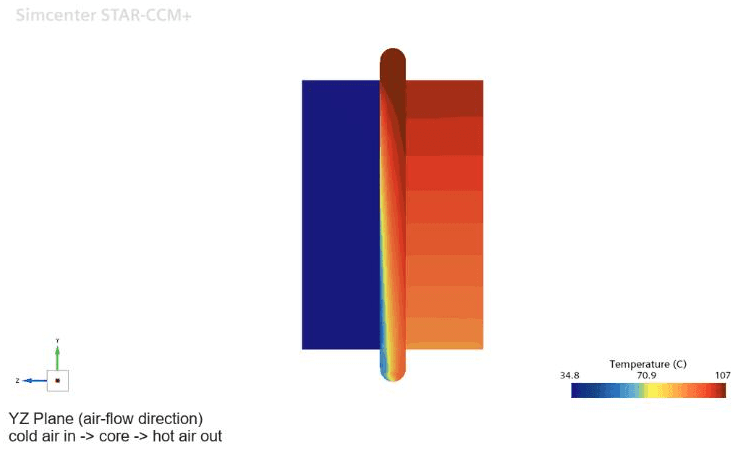
Temperature along the air path
In the flow direction, cold air enters and leaves hot as it crosses the 107 °C coolant core.

Pressure across core and tanks
The porous core holds a smooth mid-field pressure. The coolant tank runs top-high to bottom-low, the ΔP the mesh study probes.

Velocity streamlines
Air runs straight through the core near 20 m/s. The coolant tanks carry the port jets and recirculation behind the coolant-side ΔP.
Agent Design Input
Argus solved the radiator and checked its own work. Grid independence is when a finer mesh stops changing the results, so the coarsest mesh that holds is good enough. When prompted to establish it, the agent set the refinement levels, solved all three meshes, and returned the comparison below.
! Fidelity caveat, flagged by the agent
As it ran the refinement study, Argus read the trend directly. Heat rejection and the outlet temperatures stop changing as the mesh is refined, so they can be trusted. Coolant-side pressure drop is the exception. It was still rising at the finest mesh (+6.3%), driven by the complex, swirling flow in the coolant tanks. Because the core is modeled as a porous block and the run is steady-state, Argus flagged the coolant pressure-drop figure as approximate until that flow is resolved in detail.

PERCENT CHANGE FROM THE MEDIUM MESH (BASELINE). HEAT REJECTION, OUTLET TEMPERATURES AND AIR ΔP HOLD WITHIN 0.03% AND STAY GRID-INDEPENDENT. COOLANT ΔP RISES 6.3% AND STAYS MESH-SENSITIVE.
A
Why heat rejection is grid-independent
The dual-stream exchange is governed by the porous core’s UAg performance table, which doesn’t change with cell size, so refining the mesh barely moves the heat and temperatures.
B
One study, one or two prompts
The agent auto-selected the 1.41× refinement steps, built and solved Medium, Fine and Very-Fine, saved each as its own sim file, and compiled the comparison report.
→
One setup, many runs
The 296k medium mesh is enough for heat rejection and outlet temperatures. For coolant-side pressure drop, Argus can rerun at a finer mesh on demand. Because it already owns the full setup, it re-meshes, re-solves and re-checks without rebuilding the case, turning a single run into a fast design-iteration loop.
Think through > click through.
Let Argus handle the rest.
Your AI agent for engineering workflows
Want to try Argus on your own thermal workflow?
Visit www.cosmon.com to start a trial.
www.cosmon.com
